Куди піти у Львові?
The ensemble of the Assumption Church
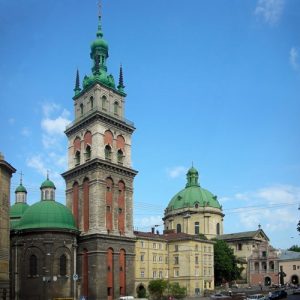
The ensemble of the Assumption Church consists of the Ukrainian Autocephalic Orthodox Church built on the site of the original church which dated back to 1461, the monumental Korniakt’s Tower, and the Chapel of Three Saints. Tha impressive Bell Tower rising up 65.8 metres was so named after its benefactor Constantine Korniakt, one of the richest merchants of his time. It was built in 1572/8 by the architect Peter Barbon and underwent several reconstructions in 1695, 1780 & 1795 before it acquired its present shape. The Bell Tower is also famous for its Bell ‘Kyrylo’ (‘Cyril’) 2 metres in diameter.
The Residence of the Emperor’s Governor General
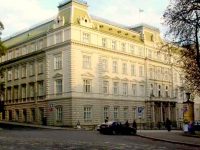
The Residence of the Emperor’s Governor General in Galicia (1884, architect Felix Ksienzharski), with its huge rectangular layout (82×49 m) and stern Renaissance façade, is a remarkable representation of supreme power in the Lviv area; a type of Australian authorities uniform, likened to an officials gown used in court proceedings, whose absence makes them totally invalid. The tall roof is decorated with lucarnes and wrought iron works of Art in French style. It commands a stunning vista of medieval Lviv. Stucco decoration of the interior by Leonardo Marconi somewhat softens the officialdom of this building.
The Dominican Church of Corpus Christi
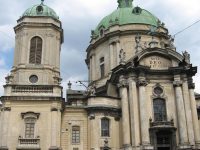
The Dominican Church of Corpus Christi (today the Blessed Sacrament Church) is Museyna Square was built in wood in the second half of the 14th c. After a fire in 1408 it was rebuilt in stone and brick in the neo-Gothic style. The present-day building was constructed in 1749/64 with funds donated by the Hetman Potocki under the management of Jan de Vitte, the Military Commandant of Kamianets – Podilsky. A hundred years later, a Belfry was added to the left side of the building.
The Armenian Cathedral
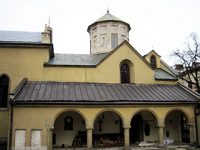
The Armenian Cathedral of the Blessed Virgin’s Assumption is Lviv’s the most exotic building that dates back the 14th century, when the Lviv became the capital of the Armenian Diocese. The Cathedral was constructed in 1356/63 to the design of the architect Doring with funds donated by the Armenian merchants. Several reconstructions and restorations were carried out with the involvement of renowned Polish architects and artists: Fr. Monczynski, J. Mehoffer, W. Minkiewicz, J. H. Rosen. The Belfry was constructed in 1571 by the architect Peter Krasowski.
The Massari (Venetian) House
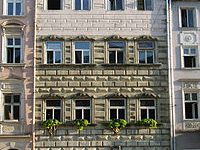
Rynok Sq., 14
In 1589 architect Paolo Romanus rebuilt the original Gothic mansion in the Renaissance style. In the 17th century house belonged to Venetian consul Antonio de Massari. Since then, the portal of the house contains a symbol of the city-republic of Venice – a winged lion with an open book with the inscription: “Pax tibi Evangelista Marce” – “Peace be with you, Mark the Evangelist”.
The Transfiguration Ukrainian Church
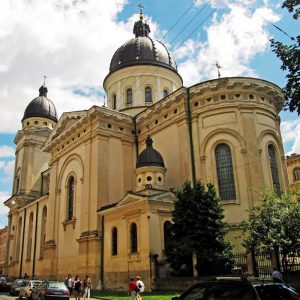
The Transfiguration Ukrainian Greek Catholic Church (21 Krakivska St) was built in 1875/98 by the architect S.Havryshkevych on the site of old Latin church and monastery belonging to the Trinitarian Order. In 1783 the order was canceled by the Austrian authorities, and the building handed over to the University. In 1848 the building was damaged by shellfire and razed almost to ashes by the fire that followed. Its remains were removed and the People’s House together with the Transfiguration Church constructed in the cleared area.
Lubomirski Palace
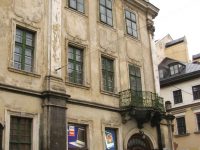
Lubomirski Palace was reconstructed in 1744 by the architect B.Meretyn with two medieval stone buildings. It was the residence of the Austrian Governors of Galicia. Since the end of 19th century it passed into the ownership of the Prosvita Society, and since then has been the home of various Ukrainian establishments. Since 1975 a collection of furniture and porcelain from the Ethnography and Arts and Crafts Museum has been on display in the building.
The Royal Palace
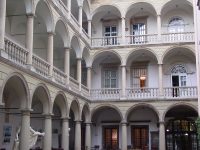
The Royal Palace built by the architect Peter Barbon in 1580 for a Lviv Merchant Konstantine Korniakt. In 1640 the building became the property of the Sobieski clan. King Jan III Sobieski was responsible for its rebuilding and restoration in 1678 (The Royal Chambers exhibition is located on the second floor). From 1908 this was the home of the Jan III Sobieski Museum and in 1940 was handed over to the Lviv Historical Museum. Italian Courtyard is especially attractive and appealing: this is the inner courtyard arranged in the pattern of similar Italian structures.
The Pharmacy Museum
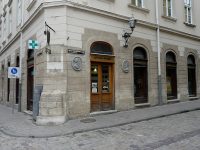
An intriguing highlight of old Lviv can be found on the corner of the Eastern and Northern side of Market Square: the Pharmacy Museum. The pharmacy has been open since 1785 and was named “Under the Black Eagle”. An intriguing room with miracleworking potions in mortars, liquid medicines in vials, and packed herbs rather resembles a laboratory of alchemists seeking to discover the elixir of eternal youth.
The Bandinelli House
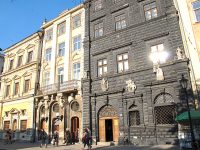
The Bandinelli House – Kamianytsia Bandinelli (Rynok Sq., 2) was built in 1593 and named after its owner an Italian Merchant Roberto Bandinelli. Being granted a Royal privilege Bandinelli ran a regular post office for local inhabitants in his house.
“Blackstone House” (Rynok Sq., 4) is the most valuable landmark of the Renaissance bourgeois construction. It was built in the years 1588-1589 by Paolo Romanus. Since 1929 this house has been home to the Lviv Historical Museum.


Hotel and restaurant complex SV


Banquet hall SV


